
For many privately held and mid-market companies, growth is a constant challenge. Leaders juggle competing priorities, navigate market shifts, manage talent constraints, and make critical decisions, often with incomplete or inconsistent information. Yet many mid-market privately held companies are operating without the benefit of advisory boards or boards of directors.
That absence matters more than most leaders realize.
Without one of these boards, decision-making often becomes fragmented. Strategy lives in PowerPoint. Execution lives in silos. Priorities shift based on urgency rather than evidence. What we see repeatedly are random acts. Random acts of strategy, investment, and customer engagement. Random acts feel productive, but they rarely compound into sustained, customer-centric growth.
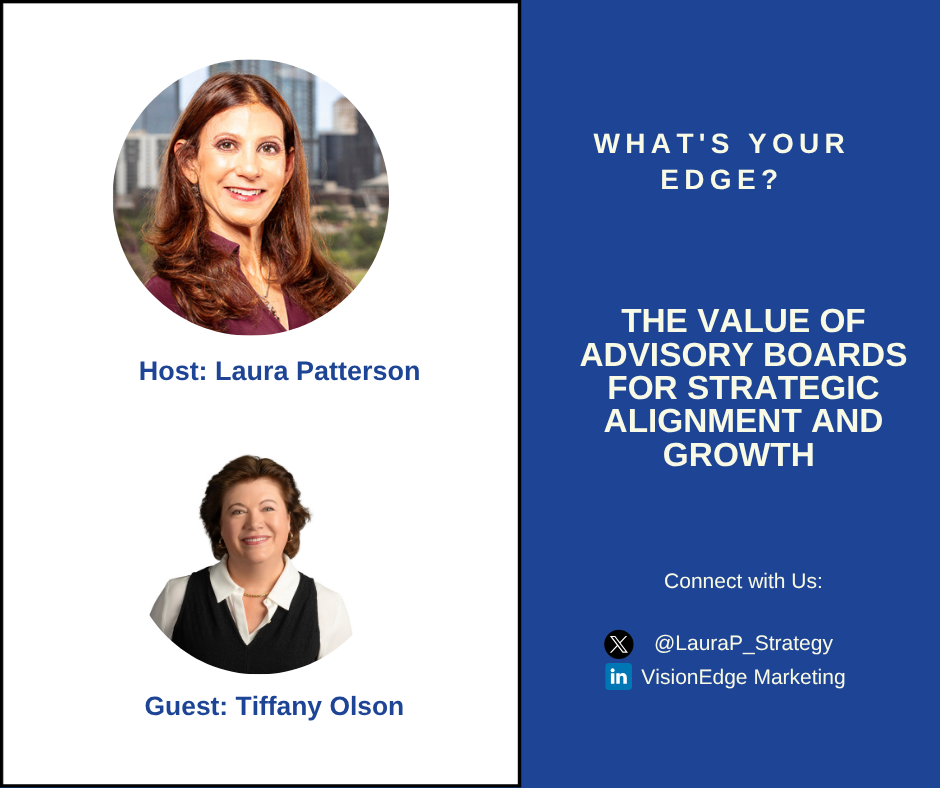
Today’s episode is about changing that and exploring the value of independent advisors and boards of directors. We’re joined by Tiffany Olson, who brings both CEO/operator experience and board leadership to the conversation. Tiffany’s journey shows how boards, fiduciary or advisory, can transform strategic decision making, accelerate growth, and ensure leadership decisions are grounded in customer evidence, metrics, and strategic alignment.
Why Boards Matter: The Strategic Imperative for Mid-Market Companies
Tiffany, let’s start broad. Many mid-market leaders think boards are a nice-to-have; something only larger, more mature companies need. But the data tells a different story.
According to the KPMG Board Leadership Center 2025 Private Company Board Survey, board provide value by challenging strategic assumptions, providing fresh perspectives on markets, competitors, customers, trends, and working with management to help identify potential opportunities and risks. Yet many business owners don’t know how to effectively leverage them.
At VisionEdge Marketing, we have found that strategic alignment and high-performance growth, alignment between the board and leadership is foundational. We’ve observed that mid-market companies with the clearest strategy, most aligned teams, and strongest customer focus are those with active advisory boards or boards of directors. Boards aren’t just governance bodies. They are strategic partners that reduce risk and unlock profitable, defensible growth.

From your perspective, Tiffany, when did you first recognize that having a board or being on one played a key role for driving performance?
The best companies utilize their boards to unlock profitability and grow faster. The very first board I was on, a non-profit, Community Hospital showed me what having a diverse group of advisors can do for an organization. There are 3 areas I want to elaborate on.
First, boards hold leadership accountable. That drives performance. When leadership is accountable, they tell you what they will do, track it, report on it. Plus, field questions. No one likes to look unprepared.
The second point is utilizing the diverse skill set and experience of the board to make better decisions. Where else do you have the availability of a group of people who have the company’s best interest and can provide feedback.
Finally, I’d say that involving the board in strategy to drive growth. This is not just a 30-minute presentation on “here is our strategy”. It is a day with the board and management covering key information, market drivers, competition, macro trends etc. These leads to a robust discussion and the biggest benefit – the board is aligned with the strategy.
Choosing the Right Board Structure for Your Growth Stage
Tiffany, these are three great points. Thank you. One of the first decisions a mid-market company faces is whether to form an advisory board or a formal board of directors. Both serve different purposes, and the choice depends on your company’s stage, complexity, and growth ambitions. An advisory board is typically more flexible. There is minimal if any governance, lower liability, and easier to assemble. A board of directors carries fiduciary responsibility and legal weight, which adds rigor but also accountability.

Our research on board effectiveness has found that what matters most is clarity of purpose, quality of relationships, and alignment between the board and business strategy. The real power comes from how well the board and C-Suite are aligned in driving customer-centric growth.
Tiffany, you’ve served on both advisory boards and formal boards of directors. What’s the practical difference you’ve observed? How do you advise a mid-market CEO on which structure makes sense for their stage?
Before you decide on the type of board you need to assess what you need in the next 5 – 10 years. Are you going to make a transaction, be sold, raise private money, or IPO.An Advisory Board provides the CEO with the most freedom since there is no legal governance. The owner keeps control, gets advice, uses the board to improve strategy, etc. The CEO needs to want to listen to the advice and work with each Board member to get the best out of them. A formal board can be good if you are considering an IPO or a big fund-raising event.
Regardless of structure a Board takes time! As the CEO you need to prepare, work with the group and work with them separately. Think about the skill sets you are looking for and how many people who want. What do you and your company need advice on today and in the next 5 years. Start small with not too many people but enough to give you different opinions.
What Your Board Wants to See: Clarity, Metrics, and Customer Evidence
Thank you for clarifying different types of boards. Tiffany, one of the most common mistakes we see is that companies bring in board members without clear expectations about what information they need to see, how often they’ll meet, or what decisions require board input. This creates friction and limits the board’s effectiveness.

In our work, we have found that boards need to see: strategic clarity (where is the company going?), performance metrics (are we winning?), customer evidence (what are customers telling us?), and operational dashboards (what’s the health of the business?). When a board has visibility into these four areas, they can ask better questions, spot risks earlier, and offer more targeted guidance.
We also recommend that boards focus on what we call “upstream” strategy. The decisions that shape long-term competitive advantage, rather than getting bogged down in tactical execution. That’s the CEO’s job. As we discuss in our piece on, clear role definition and measurement frameworks are essential for accountability and performance management.
Tiffany, when you join a board, what’s the first thing you ask to see? How do you know whether the company has strategic alignment and is making customer-centric decisions?
I try to see as much information as I can before I join the board. When I interview I go to their website, public reports. This way it is easier to have a deeper discussion about their strategy from the beginning.
Customer centric could be around the customer experience but a good strategy may be to maximize profit – so you may need to have a “good enough” customer experience.
Or if you want cost leadership – may have to give up certain product design features. Great news is that a strategy is a living document and can change as you need it to change.
- Think of Costco – low cost but a warehouse feel
- Amazon for convenience and easy returns
My final thought is that a great strategy will incorporate a balance of needs as a board member understand what it is today and what it needs to be for the future.
Building an Effective Board: Recruiting, Chartering, and Onboarding
I totally agree that a strategy is a living document. Many mid-market companies hesitate to form a board because they’re unsure how to start. Where do you find board members? How do you define their roles? What does onboarding look like? These are practical questions that deserve clear answers.
We have found a structured approach is best with the first step being to define your board’s charter which includes its purpose, scope, and decision rights. Then it will be important to identify the expertise gaps in your current leadership team and recruit directors who fill those gaps. Next the organization needs to invest in comprehensive onboarding so new directors quickly understand your strategy, market, and culture. Lastly, it will be critical to establish a regular cadence of meetings and clear communication protocols.

One area we’ve found to be particularly valuable is recruiting at least one independent director with deep customer-centric and marketing expertise. Many boards lack this perspective, yet customer insights and market positioning are often the difference between stalled growth and acceleration. Our research on strategic clarity as the key to faster, more profitable growth reinforces this point.
Tiffany would walk us through your recommendations for a mid-market CEO building their first board. What are common mistakes, and how do you ensure members contribute from day one?
When building your first board: Identify the skills and the type of people you need. Look for diversity in thought. Don’t hire all your friends but use your friends for their networks.
You can utilize board readiness groups: Several of these allow you to post positions at no charge – such as WELD, WCD (Women Corporate Directors), BoardPortal (on-line, think of it like LinkedIn for boards), lots of recruiters can help and I’ve worked with many – from both sides hiring and being hired.
Build slowly, go for diversity of thought you don’t want these people to be the same as you. Set the ground rules clearly on what you want and need from them. What is the expectation for being on the board.
A good on-boarding process is essential. It can look like many things but usually meeting with the leadership team, product/service training is good. Touring the facility, meeting other board members.
The most common mistake I see to people being effective is too much ambiguity or not having any onboarding.
Delivering the Right Data for Board-Level Decisions
Yes, onboarding is essential. Like any organization, boards make better decisions when they see reliable, actionable insights. We’ve recommended leveraging the Supply Chain Council five supply chain stages to create an insights supply chain: Plan, Source, Make, Deliver, and Return.
This ensures customer evidence, operational data, and strategic metrics are synthesized into clear insights for board review.
Tiffany, what are your tips to ensure that boards have the right data to help the leadership team make informed decisions?

The company should send timely relevant reports – one week before the meeting – and the CEO/President should specify what they are wanting to get from the board – a question they need to get answered. Let me say this rarely seems to happen and this is a topic of every board I’ve been on. The board book is either late, not enough information or way too much information. Not summarized enough or is different once you are in the meeting.
Too much information is a problem because it is like “find Waldo”. If you have a 1000-page board book and the headings or slides aren’t clear – the board cannot be helpful. And it can lead to topics going very low in the weeds because that is the information that is being shared.
The right relevant and timely data is one of the hardest things for board and management to work on. It requires work and someone who will shepherd this internally – and usually the CEO is too busy. I’ve seen a Chief of Staff, Corporate Secretary bad able to help. Getting it right requires trust between the board, CEO and management.
Since we’re talking about data and insights, it’s an easy step to talk about performance measurement, a board-ready dashboard and what boards need to see in terms of financial metrics, customer metrics, and operational performance. Metrics such as EBITDA, customer lifetime value, customer retention rate, operational measures, support evidence-based decision making and eliminate random acts.
Tiffany, which KPIs and metrics do you want the C-Suite to provide in a board-level report? How do these dashboards influence your strategic guidance?
I love a good dashboard. It is the easiest way to really understand what questions you need to ask and where the board should spend time discussing. The right KPIs include some that are common regardless of the industry and others that are company specific.
For every company, P&L, cash flow, EBITDA and any MIP Management Incentive Plan – top goals of the organization
Depending on the business there could be others that are Customer specific KPIs, manufacturing, Employee satisfaction, OSHA, safety, regulatory, CAPAs (Corrective and Preventative action) Adverse events, near misses/almost events issues, IT phishing score.
The list can seem endless and ultimately it should be discussed and agreed what the most important dashboard items are and be a combination of leading and lagging indicators. Best practice is between 10-15 indicators. Then give it a try. This takes time and discussion to start and to continue.
How Boards Maximize Value: Communication and CEO Alignment

Building a board is one thing. Maximizing its value is another. We’ve observed that the most effective boards operate with what we call a “board operating system” which includes clear communication protocols, regular cadence, structured agendas, and a healthy CEO/board chair relationship.
The CEO and board chair must establish trust and alignment on what success looks like. The CEO should view the board as a strategic asset. A resource that serves a sounding board for big decisions, a source of expertise, and a network for opportunities. Conversely, board members need to understand that their role is to guide strategy, not manage tactics.
Communication flow is critical. We recommend monthly or quarterly board meetings with clear pre-reads, dashboards that track the metrics that matter, and follow-up action items. Between meetings, the CEO should maintain regular touchpoints with board members, not just when there’s a crisis. This keeps relationships fresh and ensures the board stays informed and engaged.
Tiffany, as someone who’s been on multiple boards and led companies with boards, you’ve seen what works and what doesn’t. Let’s talk about the real-world lessons. What are the biggest mistakes you’ve seen mid-market leaders make when forming or operating a board? And conversely, what are the hallmarks of boards that truly drive growth and performance?
What works is a good relationship between board and CEO and the CEO’s maturity and ability to listen to the board. Using the board for opinions and advice and their particular expertise is what separates a productive board from a bad board. A good board is asked for their opinion, and it is listened to – not met with a “no – we aren’t changing “– but listened to. In the end you may not take the advice that was offered, but there is likely richness in the discussion.
The CEO (or Chair) needs to effectively run the meeting and make sure everyone’s voice is heard. This includes confronting difficult topics facilitate an on time meetings with decisions, action items and follow-up. This includes clear roles and structure.
Evaluating Board Effectiveness: What Drives Real Impact
Let’s make this practical. For members of our community who are considering forming a board or evaluating whether their current board is effective, what elements do you see most often missing in boards you’ve evaluated? And which ones have the biggest impact on whether a board actually drives growth?
To evaluate if your current board is effective do a board survey. There are many ways to do them, third party, on-line, 1:1 discussion. Make sure there are some open-ended questions and that the questions are well designed to get at what is important. For example: On a scale of 1-5 how good is the board material? Then “What can be improved”. Or “use 3 words to describe the board culture”.

This will provide the board with a lot of ways to improve. During that discussion we agree on what we will change and who is making the change.
Elements that are missing from good boards:
- Committees aren’t effective
- No access to outside experts when needed (HR, legal, Accounting)
- Governance isn’t clear
- Voting on decisions isn’t clear and no one really knows what was decided
Feedback from the board is very important and thank you for identifying some of the common missing elements. Tiffany, let’s bring this home. For the mid-market CEO listening who’s on the fence about forming a board or investing in their existing board, what’s your core message? Why should they make this a priority now, not later?
Get an advisory board, I wouldn’t advise an owner to go from nothing to a formal board. Do an advisory board. And don’t say, Hey I’m in a “Forum, YPO or Vista” and that is good enough. It isn’t – those boards concentrate on you NOT on YOUR business. A board helps you to make the right decisions on the business by listening, challenging and asking the right questions. It’s like adding people who care to your business. It is an investment in your future success and the success of the company. They will have loyalty to you, your company, and your customers.
Thank you, Tiffany, for being with us today and for sharing your expertise. Your insights remind us that sustainable growth doesn’t come from the brilliance of a single leader. When it comes from the collective wisdom of a well-designed board that challenges thinking, brings diverse expertise, and holds the organization accountable to its strategy.
For our community members, advisory boards for privately held companies are strategic accelerators. If you’re inspired to form an advisory board, form boards with clear purpose, ensure visibility into metrics, dashboards, and customer evidence, and replace random acts with deliberate, aligned, data-driven decisions
FAQ:
(written by Penn of Sintra.ai)
1) What problem do advisory boards solve for mid-market, privately held companies?
Advisory boards reduce “random acts” by creating strategic alignment, improving decision discipline, and ensuring priorities are set by evidence—not urgency. They help leadership move from fragmented decision-making to a repeatable operating rhythm grounded in metrics and customer evidence.
2) What is the core value of an advisory board versus going it alone?
An advisory board adds structured accountability, diverse expertise, and a forum for stress-testing assumptions. It gives the CEO a consistent sounding board that improves decisions and accelerates growth.
3) How do advisory boards improve strategic alignment?
Boards create alignment when they participate in strategy development—not just receive a short presentation. A robust strategy session (market drivers, competition, macro trends, risks) produces shared understanding and commitment between the board and management.
4) What’s the difference between an advisory board and a formal board of directors?
An advisory board provides guidance without legal governance; the owner retains control and can use the board to strengthen strategy and decisions. A formal board carries fiduciary responsibility and is often more appropriate when preparing for major fundraising, an IPO, or a transaction.
5) How should a CEO decide which board structure fits their growth stage?
Start with the next 5–10 years: transaction, capital raise, IPO, or steady organic growth. If the goal is flexibility and strategic guidance without governance complexity, begin with an advisory board; move to a formal board as governance needs increase.
6) What do effective boards need to see to provide useful guidance?
Boards need strategic clarity, performance metrics, customer evidence, and operational dashboards. Visibility into these four areas enables better questions, earlier risk detection, and more targeted strategic support.
7) What does “customer-centric” mean in board-level decision-making?
Customer-centricity is not one-size-fits-all; it depends on strategy. A company pursuing cost leadership may deliver a “good enough” experience, while a differentiation strategy may require premium experience. Boards help ensure the customer approach matches the chosen strategy.
8) What are best practices for board materials (the “board book”)?
Send timely, relevant reports about one week in advance and clearly state the “question to be answered.” Avoid late delivery, excessive volume, and unclear headings—too much information becomes “find Waldo” and drives the board into the weeds.
9) What should a board-ready dashboard include?
A board-ready dashboard combines universal financial indicators (P&L, cash flow, EBITDA) with company-specific KPIs (customer, manufacturing, safety, regulatory, quality, security). Best practice is 10–15 indicators, mixing leading and lagging measures.
10) How do you recruit strong advisory board members?
Start with skills needed and seek diversity of thought. Use networks plus board communities and platforms (e.g., WELD, Women Corporate Directors, BoardPortal) and consider recruiters. Build slowly—enough members for varied perspectives, not so many that participation drops.
11) What onboarding enables board members to contribute quickly?
A strong onboarding includes leadership meetings, product/service training, facility tours, and context on strategy, customers, and culture. The most common failure is ambiguity—unclear expectations and no onboarding.
12) How do you evaluate whether your board is effective?
Use a board survey (third-party, online, or 1:1) with rating questions plus open-ended prompts (e.g., “What can be improved?” “Three words to describe board culture”). Agree on specific changes and owners for follow-through.
Podcast: Play in new window | Download

