
Across industries, growth stalls when companies rely on reactive demand, word-of-mouth, or what we call “random acts” of marketing and sales. In markets where competitors can quickly copy features, pricing, and even talent, sustainable advantage doesn’t come from doing more activity. It comes from making deliberate strategic choices and then aligning the organization to deliver on those choices consistently.
Real differentiation is not a slogan or a tagline. It is the outcome of deciding who you serve best, what problems you solve better than anyone else, and building the capabilities and operating model to make that promise reliable for customers. When strategy, structure, and execution are aligned, companies create a customer experience that is intentionally designed rather than accidentally assembled.
We’ve written extensively about how strategic alignment turns investments into high-performance growth rather than isolated wins.
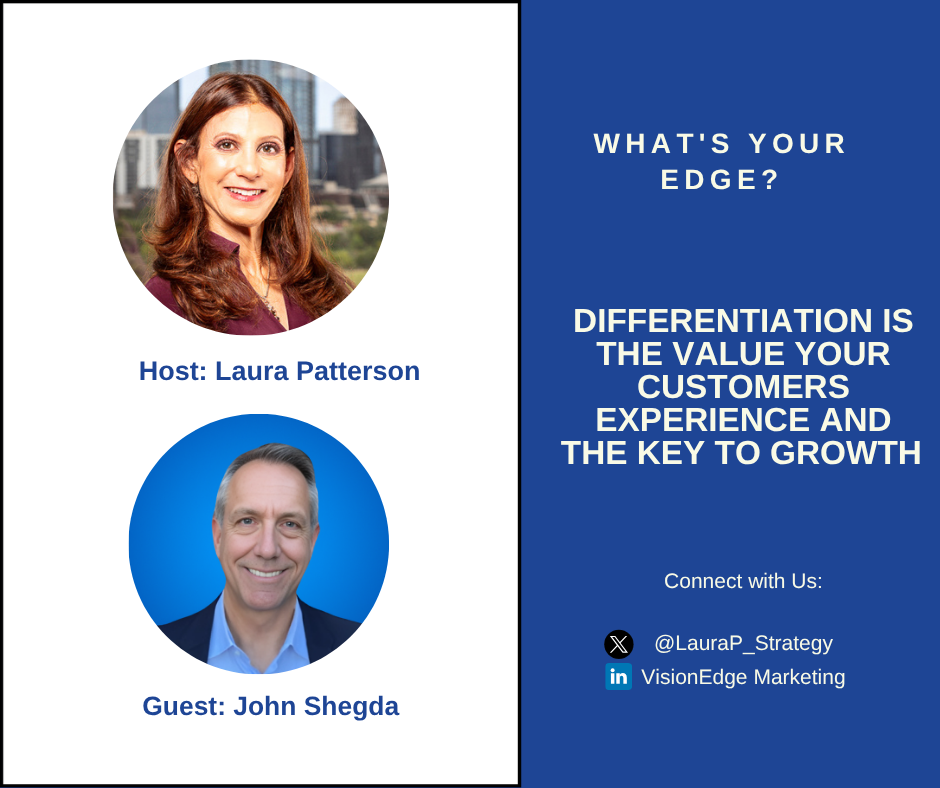
Today we’re joined by John Shegda, CEO of KMM Group, Ltd. John brings more than 35 years of experience in precision manufacturing and leadership, and KMM is known for producing critical parts others can’t or won’t make for high-stakes markets such as med tech and aerospace. Their story is really a story about deliberate operating choices: keeping capabilities under one roof, investing ahead of demand, and building a culture of communication and problem-solving that customers can feel.
Differentiation is not what you say; it’s what customers experience repeatedly and reliably.
What True Differentiation Looks Like in Competitive Markets

John, leaders in every industry are facing the same structural pressure. Buyers have more options, switching costs are lower, and “good enough” competitors can push prices down. In that environment, features and functions quickly become commodities.
What separates the companies that grow from the companies that stall is a clear, customer-anchored value proposition. Not a list of capabilities, but a statement of the specific customer outcomes you enable and the risks you remove.
When that value proposition is clear, it becomes the north star for decisions about where to invest, how to organize, and what to say no to. When it’s fuzzy, organizations drift into disconnected initiatives that feel busy but don’t compound.
We see this in our work on positioning and customer-centric growth: companies win when their promise is framed in customer results, not internal strengths.
KMM is described as a boutique contract manufacturer that makes critical parts competitors cannot. Translated for any C-Suite leader, that means: we solve the hard problems reliably and we reduce customer risk.
What do you believe is the true source of KMM’s differentiation—what customers actually experience that competitors struggle to match?
Our advantage starts with being deliberate about where we compete. We focus on industries that need multiple deep capabilities under one roof and where the work is difficult enough that customers often struggle to place it. Difficult work also requires flexibility within those capabilities. You may begin thinking one method will solve it and realize along the way that you need to pivot. We can change direction without losing momentum.
Know Which Customers You Serve Best to Successfully Compete

Being able to change direction without losing momentum is a valuable capability. In our conversations, we’ve talked about strategic clarity. We’ve described this as strategic clarity: knowing exactly where you will play and how you will win, and then aligning resources behind that choice. Strategic clarity requires trade-offs.
Many companies grow by saying “yes” to the next opportunity. That works for a while, but over time complexity increases, margins compress, and performance becomes uneven. The shift from opportunistic growth to deliberate positioning is often the inflection point that unlocks more profitable, defensible growth.
Take us back to the moment you realized KMM needed to be more deliberate about where you play and how you win. What changed, and what decision set a new direction?
It really wasn’t one moment; it was an evolution after consolidating three smaller companies into one larger operation. Once everything came under one roof, it became clear that the work supporting the smaller entities wasn’t enough to support what the larger company could become. Customer response showed us pretty quickly that the strongest opportunities were difficult, repeatable programs requiring multiple disciplines, especially in industries like medtech, aerospace, and space exploration. That’s when it became much more intentional.
Remove Friction to Improve Customer Experience and Confidence

Kudos to you and your team for paying attention to the customer response. This is a good transition for talking about how customer value often leaks at the handoffs: from sales to delivery, delivery to service, service to renewal. Customers experience these as delays, rework, and finger-pointing.
An integrated operating model where teams design, build, and solve problems are tightly connected help shrink cycle time and increase accountability. Internally that feels like collaboration; externally it feels like reliability.
Thank you for sharing a transferable lesson well beyond manufacturing. When you remove friction inside the organization, you increase speed and confidence for customers.
It’s also why clear accountability and role definition matter so much to performance.
You’ve mentioned the importance of having capabilities under one roof. How has that changed the customer experience? What does it enable your teams to do that a fragmented model could not?
For the customer, keeping capabilities under one roof reduces friction. Communication moves faster, technical questions get answered directly, and if a project needs to pivot, that can happen in real time instead of across multiple vendors. Internally, it lets teams think end to end instead of by department. A part may be in spec at one step and still create downstream problems, so having those disciplines connected in one place improves both problem solving and reliability.
Unlock Growth: Transform Your Culture into a Powerful Asset

John, I know you’ve focused on culture. Culture is often treated as an internal topic, but customers experience culture directly through responsiveness, ownership, and clarity of communication. When teams are empowered to solve problems instead of escalate them, customers feel momentum instead of delay.
Alignment between your organizational structure and your value proposition shows up in measurable business outcomes: stronger reputation, higher retention, more expansion within existing customers, and more referrals.
When structure and culture support the promise you make, teams make faster decisions and customers experience consistency. When they don’t, even talented people create friction.
This alignment between structure and value proposition is a prerequisite for loyalty and growth.
You’ve been recognized for fostering a culture of communication and innovation. What specific practices make that culture tangible, and how do customers benefit from it?
We make culture tangible by putting it in front of people every day. Our Fundamentals define the behaviors we want and the kind of company we’re trying to build. The important part is helping people understand why something matters. If someone understands why a requirement matters to the customer and to the business, they usually make better decisions. Most people want to do the right thing, they just need enough context to stay aligned.
Grow Faster by Doing What Matters to Your Customers

You’ve mentioned being known for solving difficult problems. To deliver you’ve invested in the tools, talent, and processes that make success repeatable. These investments are really risk-reduction mechanisms for your customers. Advanced capabilities are about more than increasing output. They increase confidence and enable you to differentiate KMM from competitors.
This is consistent with the broader idea of building competitive advantage through distinctive capabilities that competitors can’t easily replicate.
How do you decide where to invest, and how do you connect those investments directly to customer value and competitive advantage?
Investment decisions usually start with one question: does this make us better at something that matters to the customer? That may mean equipment, inspection technology, or people. I get just as excited about inspection as production equipment because seeing deeper into a process makes us better. We also look ahead at industries where technical demands are growing. If an investment strengthens what we already do and helps us say yes more often in our wheelhouse, it usually gets serious attention.
Invest in Capabilities that Reduce Customer Risk and Improve Differentiation
John, love the fact you focus on what matters to the customer. When organizations prioritize customer experience, they create competitive differentiation that goes beyond price or features. Customers are buying confidence that you will anticipate issues, communicate clearly, and solve problems quickly.
What does KMM do before, during, and after delivery to reduce customer risk and increase confidence?
Reducing risk starts before we ever make a part. We want direct conversation early, especially on difficult programs, because most of this work isn’t a slam dunk. We ask questions, identify likely challenges, and try to uncover what others may already have learned. During production, honesty matters. If something is hard, we say it’s hard. After delivery, we keep sharing what we learned. Trust usually comes from asking the right questions early, being realistic throughout, and continuing to improve afterward.
How to Scale Without Losing What Makes You Different

Yes, trust becomes part of the product in high-stakes environment. Let’s talk about scaling. Growth can dilute differentiation if the operating system doesn’t scale. Some companies over-standardize and lose flexibility; others over-customize and lose consistency.
The leaders who scale well are explicit about what must be repeatable and what must remain adaptable. That balance preserves quality while protecting customer value.
Strategic alignment ensures that as you grow, investments and processes reinforce your differentiators instead of eroding them.
As KMM has grown, what have you standardized, and what have you intentionally kept flexible?
If you don’t have standardization, you can’t scale. There has to be consistency in how work launches, how quality enters, how data is captured, and how accountability moves through the business. But standardization alone isn’t enough. People also need room to challenge a process intelligently. If you don’t know where a process breaks, you don’t really control it. The goal is stable systems with enough adaptability that people keep improving what those systems produce.
The Power of Recurring Revenue as a Customer Experience Metric

Recurring revenue is often labeled a finance metric, but it’s really evidence of customer experience and trust. It signals that customers see repeatable value and are willing to deepen the relationship.
We typically see recurring revenue rise when organizations improve the entire customer lifecycle: onboarding, adoption, service, renewal, and expansion, supported by shared metrics and accountability.
Delivering a clear, customer-centric value proposition is what makes that lifecycle repeatable.
What changed in your approach to create more ongoing, repeatable value for customers?
Repeatable value comes from solving difficult problems in the right industries. A customer brings something hard, often tied to a disruptive technology, and the first step is solving it technically. The second is systemizing that solution so it becomes repeatable and scalable. That’s when you become more than a supplier and start becoming part of commercialization. We’re drawn to industries where innovation is moving fast because that’s where technical adaptability matters most.
Connect Data to Decisions and Eliminate Random Acts

As organizations scale, intention must be reinforced by measurement. Otherwise even good strategies will devolve into disconnected initiatives.
Leaders need a shared dashboard that links financial results, customer value, and operational performance. Metrics such as retention, customer lifetime value, quality, and cycle time translate differentiation into evidence.
When these measures are visible and discussed together, teams optimize for customer outcomes, not just local activity. That’s how you replace random acts with deliberate, compounding decisions.
Prioritizing customer experience and measuring what matters is a direct path to customer-centric growth.
How do you ensure your teams have the right data to make better, faster decisions for customers?
We’re still refining metrics because every company has numbers, but very few have the right ones. For us, earned hours has become useful because it ties quality, delivery, and efficiency together in one measure. If a job is estimated at 100 hours and completed in less time, that reflects process improvement. If rework happens, the metric shows it right away. A metric only works if people understand what it means and how their decisions move it.
Leadership Imperative: Align Strategy, Capabilities, and Execution

For leaders trying to escape commoditization, the mandate is clear: articulate true differentiation, invest in the capabilities that make it real, and align structure, culture, and metrics around customer outcomes.
Positioning and messaging only work when the organization can consistently deliver what the message promises.
If you were advising a CEO or board in another industry, what principles should they apply immediately, and what common mistake should they avoid?
The advice I’d give any leader is pick something you genuinely do well and go deep in it. A lot of companies try to be everything, but specialization matters more than ever. You can have connected capabilities, but there needs to be a true center where you can honestly say this is what we do exceptionally well. The biggest mistake is trying to be all things to all people or pretending to be further along than you are. People respond to clarity and honesty.
John, thank you for joining us and for sharing how disciplined differentiation, capability investment, and customer experience can become a growth engine.
For members of our community, who want to make this practical, start by pressure-testing your own differentiation. Can every leader clearly articulate your value proposition, the customer risks you remove, and the few capabilities you must excel at to deliver that value every time?
Then look at your operating model and your metrics. Do your structure, processes, and dashboards reinforce that promise, or are they optimized for internal convenience?
If you want to outdistance competitors, align what you say to the market with how your organization actually works.
If you’d like help assessing and strengthening that alignment, let’s have a conversation.
FAQ:
(written by Penn of Sintra.ai)
What is differentiation (in practical terms)?
Differentiation is the value your customers experience repeatedly and reliably, not a slogan, tagline, or list of features. It is proven through consistent outcomes, reduced risk, and a customer experience that feels designed—not accidental.
Why do companies get commoditized even when they do “great work”?
Commoditization happens when buyers can easily compare providers on surface-level attributes (features, price, speed) and switching costs are low. Without a clear, customer-anchored value proposition and aligned execution, companies default to reactive demand, word-of-mouth, and random acts that do not compound into durable advantage.
What is a customer-anchored value proposition?
A customer-anchored value proposition is a clear statement of the customer outcomes you enable and the risks you remove. It is not a capability inventory; it is a decision tool that guides where to invest, how to organize, and what to say no to.
How does strategic clarity help leaders escape “random acts” of marketing and sales?
Strategic clarity defines where you will play and how you will win, then aligns resources behind those choices. When leaders use strategic clarity as a north star, they reduce disconnected initiatives, improve prioritization, and create an operating rhythm that reinforces differentiation.
What does “strategic alignment” mean at VisionEdge Marketing?
Strategic alignment is the discipline of connecting strategy, structure, capabilities, culture, and metrics so the organization can deliver its value proposition consistently. Alignment turns investments into high-performance growth rather than isolated wins.
How does an operating model influence customer experience?
Customer value often leaks at handoffs—sales to delivery, delivery to service, service to renewal—creating delays, rework, and finger-pointing. An integrated operating model reduces friction, shrinks cycle time, increases accountability, and makes reliability visible to customers.
Why is culture a growth lever (not just an internal topic)?
Customers experience culture through responsiveness, ownership, and clarity of communication. When teams understand the “why,” they make better decisions, solve problems faster, and create consistency—key ingredients for retention, expansion, and referrals.
How do capability investments create competitive advantage?
Capability investments are risk-reduction mechanisms for customers. When you invest in tools, talent, inspection/insight, and processes that make success repeatable, you increase customer confidence and build distinctive capabilities competitors cannot easily replicate.
What is the link between customer experience and recurring revenue?
Recurring revenue is evidence of customer trust and repeatable value. It rises when organizations improve the full lifecycle—onboarding, adoption, service, renewal, and expansion—supported by shared metrics and accountability.
How can leaders scale without losing what makes them different?
Scaling requires clarity about what must be repeatable (launch, quality, data capture, accountability) and what must remain adaptable (problem-solving, intelligent process challenge). The goal is stable systems with enough flexibility to keep improving outcomes.
What metrics help connect differentiation to decisions?
Leaders need shared dashboards that link financial results, customer value, and operational performance. Metrics such as retention, customer lifetime value, quality, and cycle time translate differentiation into evidence and help replace random acts with deliberate, compounding decisions.
What is a “performance management dashboard,” and why does it matter?
A performance management dashboard is a shared view of the measures that guide decisions and operating rhythm across teams. It helps leaders manage trade-offs, reinforce priorities, and ensure execution supports the customer outcomes promised in the value proposition.
What is the leadership imperative for escaping commoditization?
Articulate true differentiation, invest in the capabilities that make it real, and align structure, culture, and metrics around customer outcomes. Positioning and messaging only work when the organization can consistently deliver what the message promises.
What common mistake should CEOs and boards avoid?
Avoid trying to be all things to all people—or pretending to be further along than you are. Specialization, clarity, and honesty create trust and make differentiation believable.
Podcast: Play in new window | Download

